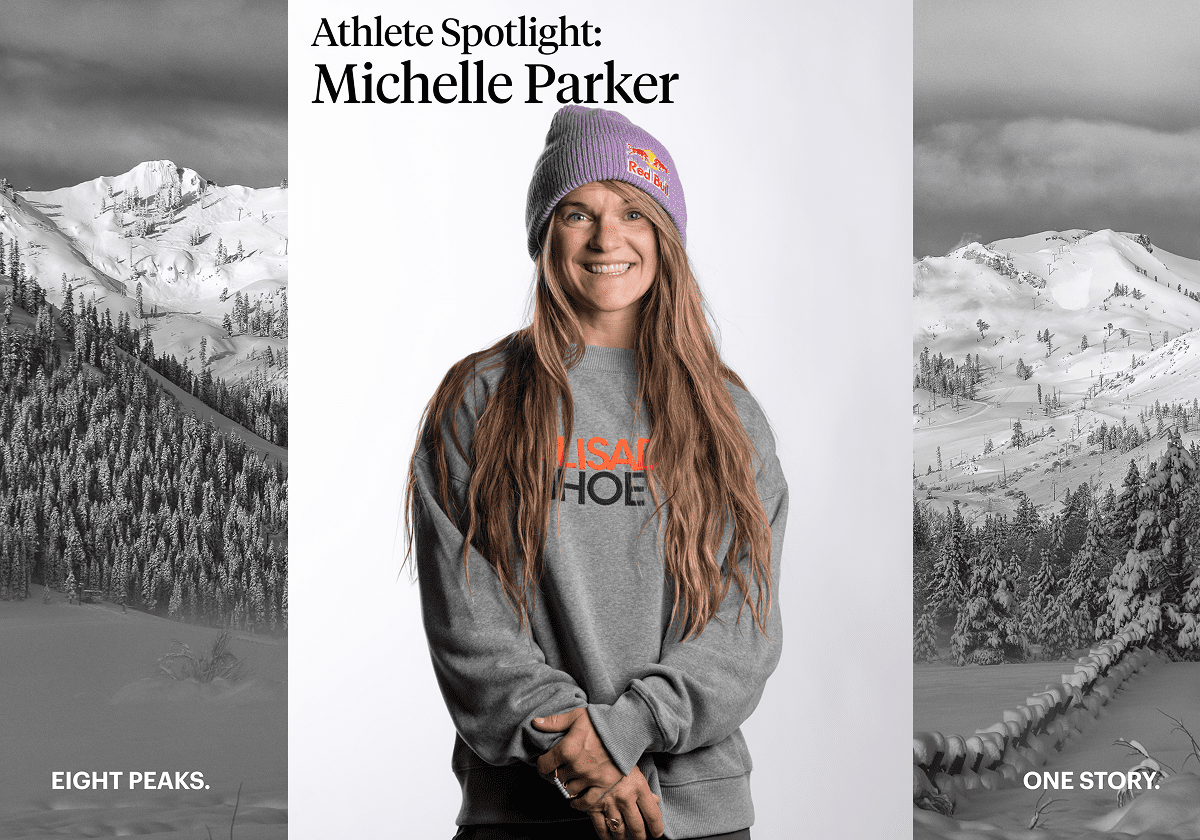
Michelle has influenced the ski world through success in nearly every discipline the sport has to offer: racing, park, freeride, and filming. Born and raised in Tahoe, Michelle first put on skis at 18 months old! Michelle quickly grew a niche for ski racing, which then transferred into a love for park. By 17, she competed at the first-ever X Games for female skiers.
After a devastating knee injury that threatened to end her career, Michelle staged one of skiing’s most remarkable comebacks, earning Matchstick Productions’ Skier of the Year and a spot on the Red Bull athlete roster.
Starring in over a dozen ski films, Michelle has paved an incredible legacy for female skiers for generations to come. Red Bull’s Originate series offered Michelle a chance to tackle directing, producing, and starring in episodes designed to showcase women’s stories in skiing.
Michelle’s genuine love for the mountains and Tahoe shines through her advocacy work with High Fives, The Washoe Tribe’s Cultural and Outdoor Expedition Program, and Protect Our Winters. Thoughtful, humble, and charismatic, Michelle is a devoted daughter, sister, wife, and friend. Our team sat down with her to explore how she successfully navigated so many disciplines as a pro athlete and her passion for skiing and the Tahoe community.
Michelle, age 4, cruising in her pink snow suit while her father Greg Parker, narrates
When did you first get on skis?
I started skiing because my mom and her group of friends had a pact to get their kids on snow before they turned two. When I was 18 months old, she first put me on skis, and we would go to Palisades. I obviously don’t remember it, but it was my mom and her girlfriends’ way of getting on the mountain with their littles.
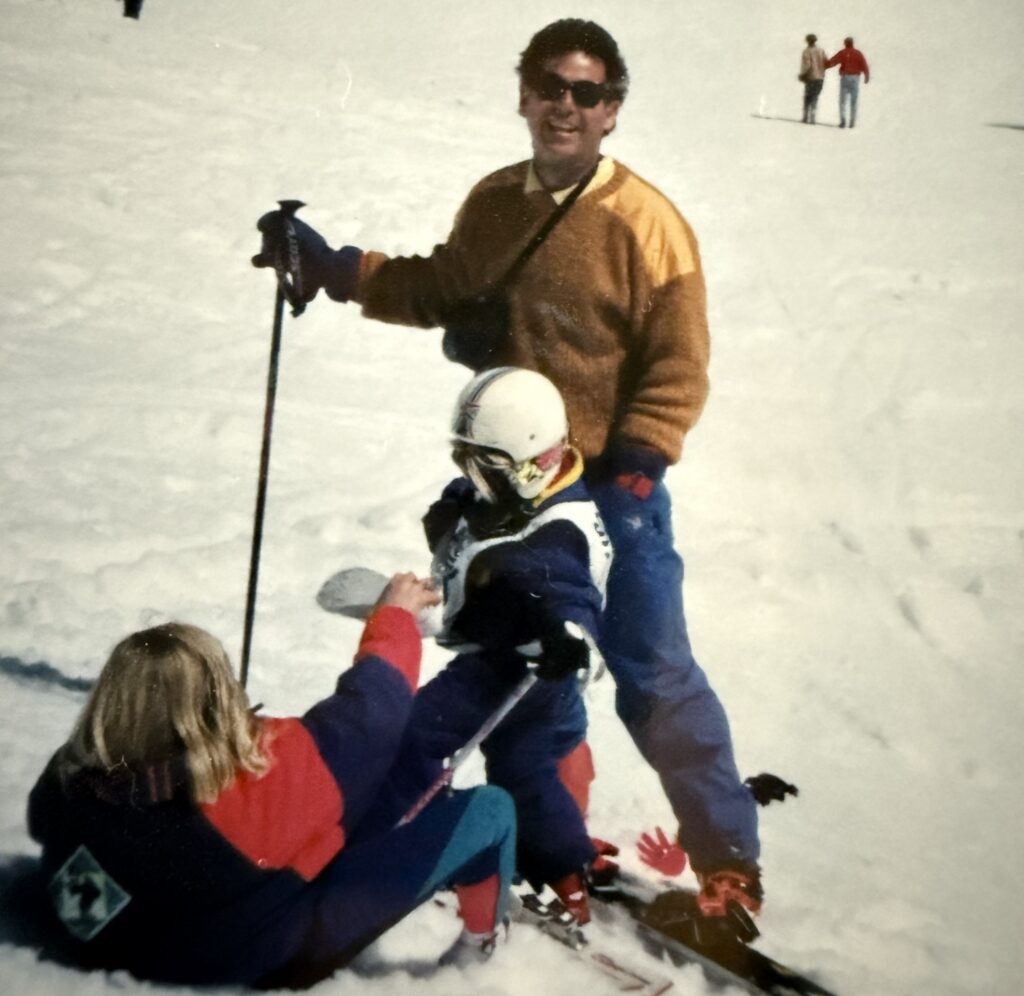
Michelle with her parents, LouAnne and Greg
What was your development path as a skier? Did you go through the Teams programs?
I feel incredibly fortunate and privileged. I started skiing at Mighty Mites when I was four. Our school system allowed students to take physical education as a course, so from 12pm until 4pm, we’d get to ski at Palisades.
The program wasn’t necessarily designed to produce serious skiers, but some aspects resembled a ski academy. I went through Mighty Mites and then started racing through the race program. At 15, I stepped away from racing and entered slopestyle and halfpipe. I was really fascinated by the park. I had a fun group of friends, and I competed in the very first X Games for women when I was 17. I was still in high school and traveling to the US Open, European Open, X Games, and more. My teachers weren’t quite used to all the travel requirements.
When I first started skiing, I didn’t know that it was possible to be a professional female skier. All I saw was a lot of men out there. One day, I was riding through the park at Palisades with my trademark long braid. This guy came up to me and handed me his business card. It was Jason Levinthal, who owned and founded J Skis. He was my first sponsor, and he told me, “I thought you were a boy until I saw your braid. You should compete.”
How did you balance skiing with other sports growing up?
I played a lot of different sports growing up. My dream was to become a professional soccer player. Mia Hamm was my hero. My mom would take me to all the games, including the World Cup when it was held in the US. I was on the Nevada State team, and in 2002, I tried out for the California State team —the same year that Megan Rapinoe tried out. I was half as big as all California players and questioned if I was cut out for professional soccer.
My parents drove me to Davis from Reno for soccer practice. I was 14 when my club team started traveling internationally, and I got the dreaded ultimatum from my soccer coach: soccer or skiing. I think when you’re that age, and someone forces that decision on you, you rebel. I decided on skiing, an obvious choice for living in Tahoe. I continued playing soccer for North Tahoe High School, but around that same time, I was transitioning into getting contracts and deals in skiing.
Who are some mentors, coaches, or friends that influenced your ski journey?
All the coaches in the system at Palisades truly shaped my love for skiing. When I was a racer, I was coached by Todd Kelly, who was one of my favorites. If I showed up to go train on a powder day, he’d exclaim, “What are you doing? Go have fun!” He instilled the fun aspect in me and in skiing, and he knew that more time on skis makes racers better. So, I would go make laps and then come back in the afternoon when the powder was gone and train in the racecourse. Racing helped me develop a strong technical background. I loved racing, but ultimately, I found so much freedom in using the mountain and having less structure. That’s when my full love for skiing began.
Alongside Todd, I was coached by John Walsh, who is still heavily in my life. John would compare how I skied slalom to how I juked someone in soccer. Another notable coach was Tim Critz from Mighty Mites. I would ski with him and play hide and seek on the mountain. He’s the one who showed me how to jump my first cliff. All the coaches that were in the system at Palisades truly shaped my love for skiing and how I viewed the mountain.
When did the transition occur from racing to freeride and park?
I grew up as a total tomboy and pushed myself on skis in many ways because of my peers. When you’re skiing around with a rat pack of kids, you’re skiing fast and fluid while exploring this beautiful mountain.
Tim Dutton has been my best friend since the womb! He and my other guy friends taught me how to hit rails, jumps, and front flips. There wasn’t an established freeride program yet. We would ski in the park where our peers doubled as our coaches. To me, that’s when freeride and freestyle park skiing blossomed, because it was unstructured.
When I was 15, skiing in the park, I had just gotten sponsored by Rossignol for racing. I won Junior Olympics and was on track to be a professional ski racer. My coaches pulled me aside and tried to lay down the law, “You can’t go upside down, you have to wear a helmet, and you’re not allowed to ski with the boys.” Again, when you’re that age and you have a rebellious edge, you’re probably going to go in the opposite direction. So, I continued skiing in the park, and when Jason handed me his business card, I realized there was another avenue to pursue.
I transferred my money from the race program at 15 to the newly started freeride program. I really started to grow in the park with coaches and guidance. At my first US Open, my only trick in the air was a front flip, but I was good at rails. That was the first time that I saw Kristi Leskinen and Sarah Burke. There were maybe ten women competing internationally at the US Open, and I was impressed to see other girls, period, and other girls who could rip. Being exposed to other women skiers helped me mentally and technically; I learned a 360 at that comp. When you see it, you can believe it.
How did you get started with filming?
Growing up in Palisades, Alice’s Market was the place where you could rent Warren Miller or Matchstick Productions videos. Skiing at Palisades, you were watching people like Ingrid Backstrom, Shane McConkey, JT Holmes, and CR Johnson. A lot of big-name pros that made it and are legends in our sport came from this valley. It was so cool to be skiing here and then go home and rent the ski movies that were all shot in the valley.
I grew up in an environment that was both energetic and rebellious. Back in the day, you didn’t have to be such a specialist in your sport. You could do everything: I skied halfpipe, I skied slopestyle, and I filmed a video part all in the same year.
I had people like Brad Holmes who took me under his wing. Brad was the first person that my dad ever let me go on a trip with, unaccompanied by a parent. I always questioned his decision there, but it was really fun. We pulled out of the driveway in his huge, lifted truck en route to Jackson Hole.
I was 16 when I first hit the main air off the Fingers. I was skiing with Ryan Scardigli, and he was hyping me up. We’re on the fourth chair on a powder day, and I raced down following him. I caught a tip on a tree and tomahawked. I got scared to go onto the cliff by myself and figured I had blown my opportunity.
It was about 2pm when Ryan noticed a landing still there. We got fresh powder tracks off the Fingers, landed it clean, and skied away. Scott Gaffney happened to be on the chairlift riding up and was like, “Who was that? Was that a girl?” JT Holmes replied, “Yeah, that was Michelle Parker.” Scott immediately hunted me down and wanted to film, and that’s how my big break with Matchstick started.
Filming requires a lot of professionalism. I worked hard, but in your first year, you don’t always nail it. I got a Friends segment, which gave me credibility in the filming industry.
What is a standout Matchstick film in your career?
Superheroes of Stoke is the segment that stands out and means the most to me. It was released in 2012, when I was 20 and balancing competing and filming.
I went up to Retallack, British Columbia, to celebrate and ended up with a new injury to add to my repertoire. I hit a cliff, and my binding landed perfectly on a rock, which blew my ACL, my meniscus, and my medial patellofemoral ligament (microfracture, cartilage damage, the whole gamut). I needed multiple surgeries to recover. My dad never shared that the doctor told him I would never ski again due to the extent of the injury and damage.
Unbeknownst to me, I spent almost two years hyper-focused on a successful recovery. This was right around the time of the announcement that slopestyle would be an event in the 2014 Sochi Winter Games. I was conflicted about whether to pursue slopestyle in the first-ever Olympics or continue with my path of filming. Growing up here enforced that my favorite moments were skiing powder. The mountains were and are my favorite place, where I feel the most grounded and myself. The structure of competitive skiing always seemed to take away from that other vibe that I was so drawn to. When you’re in a competition, you’re competing against everyone else. On the contrary, when you’re out filming, you’re competing against yourself, and everyone’s on your team.
Once I recovered, I went into the mountains for a couple of hours and decided to pass on the Olympics and pursue filming. Making that decision was hard, especially because I was on the podium at nearly every slopestyle competition.
Losing all my sponsors at 20 was a low moment. I’d just bought my first house in Tahoe, and was struggling financially. I tried to shift my mindset around the fact that I was still really young and had an incredibly successful career. All was not lost. I could continue skiing or I could go to school and have a more structured, normal life.
I wanted to get the ball rolling again, so I picked up the phone and started calling people, including Steve Reska, a cinematographer for Matchstick at the time. He was stoked to film again with me, but I had to come clean about my situation of having no active sponsors. This definitely wasn’t ideal, but I was a blank slate to work with new brands.
Typically, with filming, your brand sponsors the movie, and then the brand’s athletes are featured in the movie. He responded, “All right, I’ll make some phone calls.” He was successful, and I signed with Mountain Hardwear and Atomic.
Suddenly, I had sponsors again after this big injury, with little expectation of a comeback. I slowly tapered back into training at Palisades. Every time I got back on the snow, I was in tears of joy and happiness. I was reminded of my love for the sport and this feeling that I’m addicted to. Skiing is my passion and how I want to live my life.
I had a lot of insecurity before filming. But I think when you enter a season with zero pressure, you end up skiing really well. I flew to Seattle for the Matchstick world premiere, and Steve Reska wanted to pick me up from the airport. I thought this was a bit strange, as I had team managers who could do this, but he insisted.
Steve had recently left Matchstick to work for Red Bull, and he greeted me with a Red Bull hat in his hands. He explained that I made the team. I was so shocked. I went from not being able to pay my taxes, almost thinking I was going to lose my house, to “You’re on Red Bull.” It was crazy.
At the premiere dinner, I’m wearing my new Red Bull hat and feeling such immense gratitude for this unbelievable comeback. Then it got even better; the Matchstick director announced that I won Skier of the Year. Shortly after, my team manager for Mountain Hardwear unexpectedly gave me a $5,000 bonus. This was the true comeback moment of my career and set me up for future success.
Check out Michelle Parker’s profile on Red Bull.
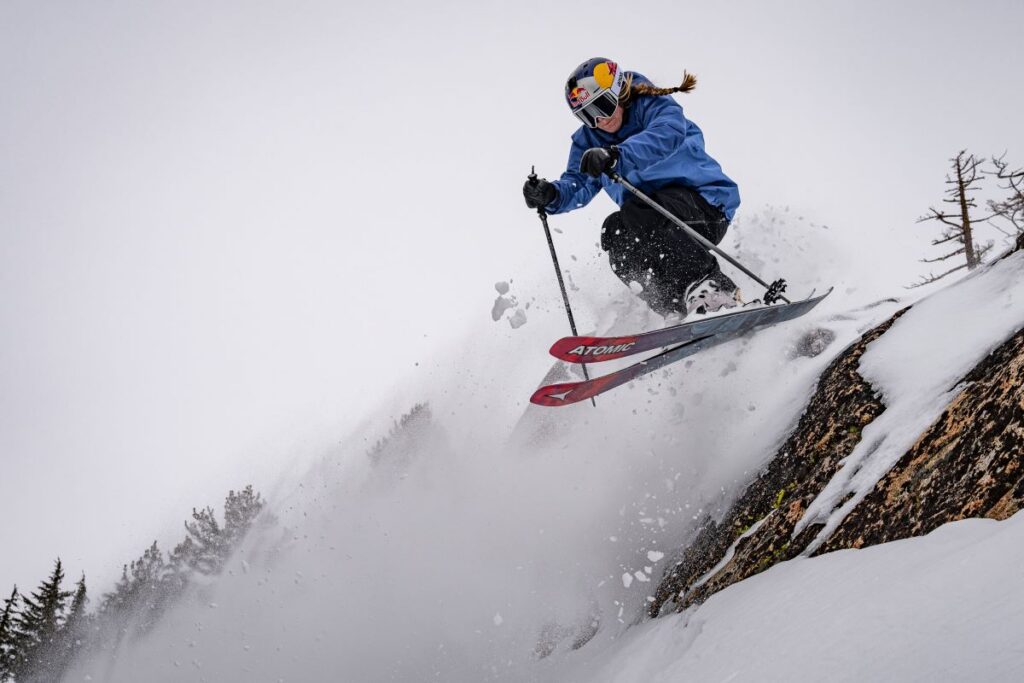 Michelle skiing with her Red Bull helmet
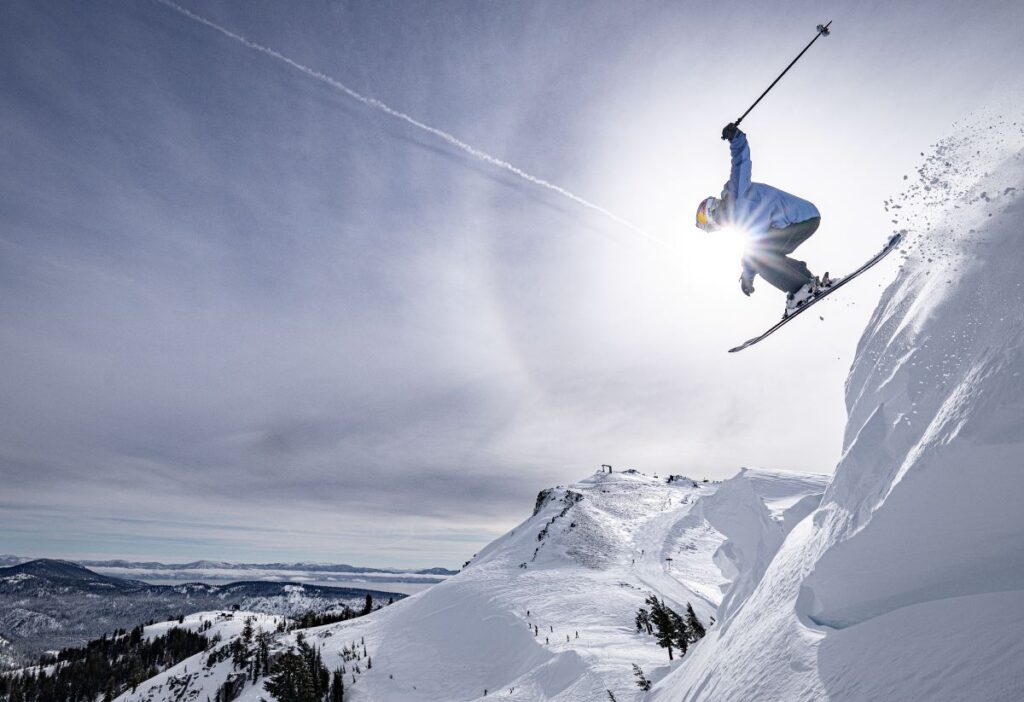 Michelle skiing with her Red Bull helmet
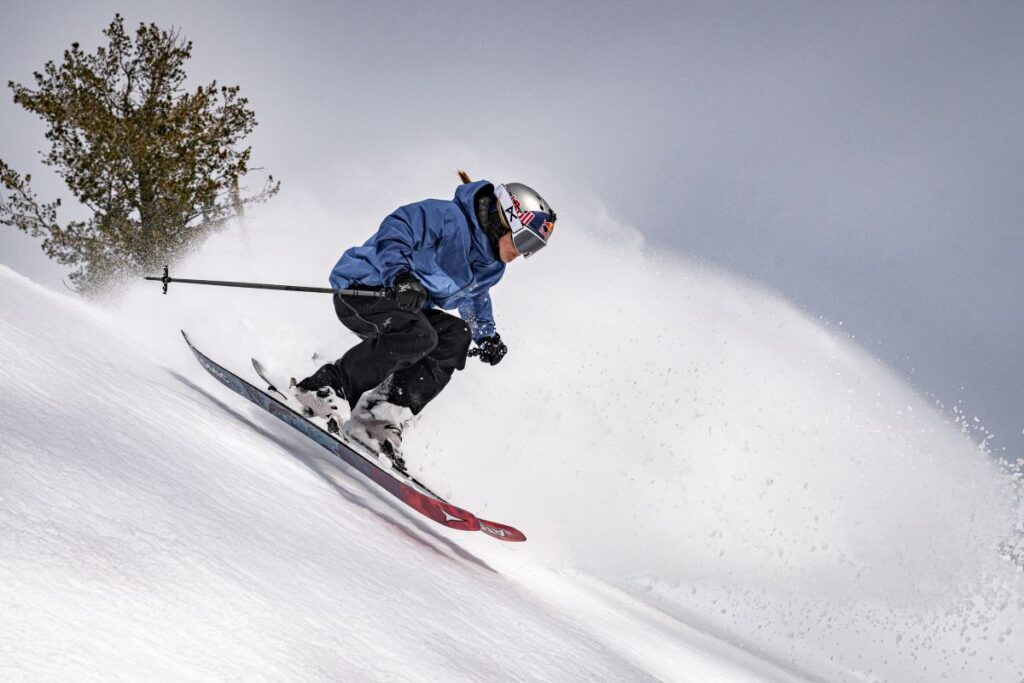 Michelle skiing with her Red Bull helmet
What was the inspiration behind the Originate film series?
Surprise, I had another knee injury and was recovering. Luckily, it was a minor one compared to my previous saga, but I was watching Red Bull TV and realized how few films featured women, much less women-centered stories. I brought this up to Red Bull and explained my desire for more representation. They responded, “Well, if you’re going to complain, pitch something.”
I had a very clear vision for this project. I hired a strong Canadian filmmaker I had traveled and filmed with, who had experience with National Geographic and Red Bull. We built out a pitch deck together, and Red Bull green-lit the project.
My entire career has been about evolution. I started ski racing, moved into park skiing, then into backcountry, and eventually, guide school. After years of incredible mountain experiences, I felt ready to tackle something new, and this project was my new inspiration. Instead of one film, we were producing six or seven episodes, which required constant hustle.
Today, in the winter, we gather for the Alpenglow Sports speaker series and listen to inspiring guest speakers. I wanted Originate to be modeled after the joys and challenges of storytelling. Originate gave me the chance to learn how to be a producer, which dramatically increased my workload and responsibilities, but it also allowed me to focus on what I cared about most: telling meaningful stories. Storytelling is so pivotal to mountain culture, and that tradition goes back to Indigenous cultures.
The Natural Selection Tour is competition series created by pro snowboarder Travis Rice that incentivizes competition and creativity at the highest level in big mountain. In 2025, Natural Selection opened their doors to skiers and hosted the world’s best male and female skiers, including Michelle, to compete in Alaska. Michelle breaks down her mindset behind training, comp day, and her impressive 2nd place finish.
Natural Selection has returned again to the big stage and used Palisades Tahoe as a venue for its Ski Super Session, filmed in February. Michelle attended to mentor and support the athletes alongside conducting interviews for the film team.
Watch the Palisades Super Session on Red Bull TV to see who qualified for this year’s NST Ski competition.
What was your experience competing in Alaska with the 2025 Natural Selection Tour?
I have so much respect for Natural Selection. I attended events, watched friends compete on the snowboard side, and always wondered if I would ever want to return to competing if skiing was in the picture.
This past season marked the first-ever Natural Selection ski event, and I was one of four women invited. Training for the comp completely restructured my year. I went back to park skiing to dial in my tricks, signed with Atomic to get back on making twin tips, and used Palisades as my training ground. It felt like stepping back into my park era.
When I got to Alaska, I underestimated the mental load. Competing on such a massive stage with global broadcast pressure was intimidating, especially alongside younger athletes like Manon Loschi, who I consider one of the best freeriders in the world. My nerves were intense, to the point where my nervous system felt off.
The buildup was unusually long. We stared at the face for nearly two weeks, studying photos and lines, which gave me far too much time to think. Normally, you arrive, have minutes to pick a line, and then you ski. The anticipation was exhausting. I was having fun, but my body was vibrating with nervous energy at night.
On competition day, everything moved fast. You get flown to the top, ski a massive face, your legs are burning, you do a quick interview, and then you are immediately back in the helicopter for run two. The face was enormous, far bigger than anything we typically film.
On my first run, I went for airs, but the snow conditions were terrible, and I fell multiple times. For run two, I focused on staying on my feet and skiing fast, which is difficult in heavy Alaska snow. I kept it clean, added small airs, and made it down—advancing to the finals with Manon.
My first run in the finals did not go according to plan. I hit ice, lost a ski, and tomahawked down the face. For my second run, I chose a line with a cliff, but hesitated briefly at the top, I actually said out loud, mic’d up, “Well, you’re the one who got yourself into this.” I stomped the landing and skied the rest of the line clean. If I hadn’t paused, I might have won. Manon didn’t hit airs, but skied fluidly and took first.
I walked away from that comp extremely proud of second place. Ultimately, the experience confirmed that competitive skiing is not where my heart lives, but I have immense respect for those who thrive in that environment. Bringing the competition to Palisades feels like a perfect fit.
How did you get involved with advocacy? What organizations are most special to you?
Advocacy has been a through line in my entire ski career. When I was younger, sometimes I felt that skiing was an awfully selfish job. I get to pursue what I’m passionate about and travel the world with my sponsor’s money. When I matured a bit, my thought process changed: If I actually become an established professional athlete, then I can give back and do valuable things with my time and platform.
High Fives Foundation was the first organization that I worked with. Roy Tuscany and I connected through physical therapy. When he started High Fives, I was on the board. I’ve skied with adaptive athletes and was so inspired by how Roy created this opportunity to give back. This eventually led me to play softball for the High Fives team. During COVID , I helped raise money to feed local families, and when Sarah Burke passed away, I raised a bunch of money for her foundation.
I was introduced to the Washoe Tribe’s Cultural and Outdoor Expedition Program when an opportunity came to join a bike ride. It was really inspiring to share a bike ride with those who have such a different and unique background. From there, I established personal relationships with the group, and we did every activity under the sun: downhill skiing, cross-country skiing, snowshoeing, and biking.
I’ve found that when such big things are happening in the world, it can be helpful and less overwhelming to focus on your local community. When opportunities arise, I want to fundraise and give back to the Washoe Tribe.
In 2024, Specialized gave me the opportunity to donate a mountain bike to a young rider named Lance from a nearby reservation. His community had experienced significant loss with overdoses, and visiting in person was important to me. Lance has turned into a ripping mountain bike rider, and the community is building their own bike park.
When the program started, there were between 30-40 youth on parole, and after the program started, there have been fewer than three. One program cannot take all the credit for this, but to play some role in fostering a love for the outdoors is extremely meaningful.
I’ve also been heavily involved with Protect Our Winters (POW), witnessing the shift from urging customers and businesses to ditch single-use plastics to writing legislation for our political system. Protect Our Winters is incredible at advocating for changes made at the top level of our government. I’ve spoken at our local town halls and with members of Congress.
The smallest things make a huge difference, like campaigning and making phone calls, and urging people to vote. POW has been an incredible organization to be associated with. The fact that it was founded by Jeremy Jones, one of my biggest mentors, makes it even more special.
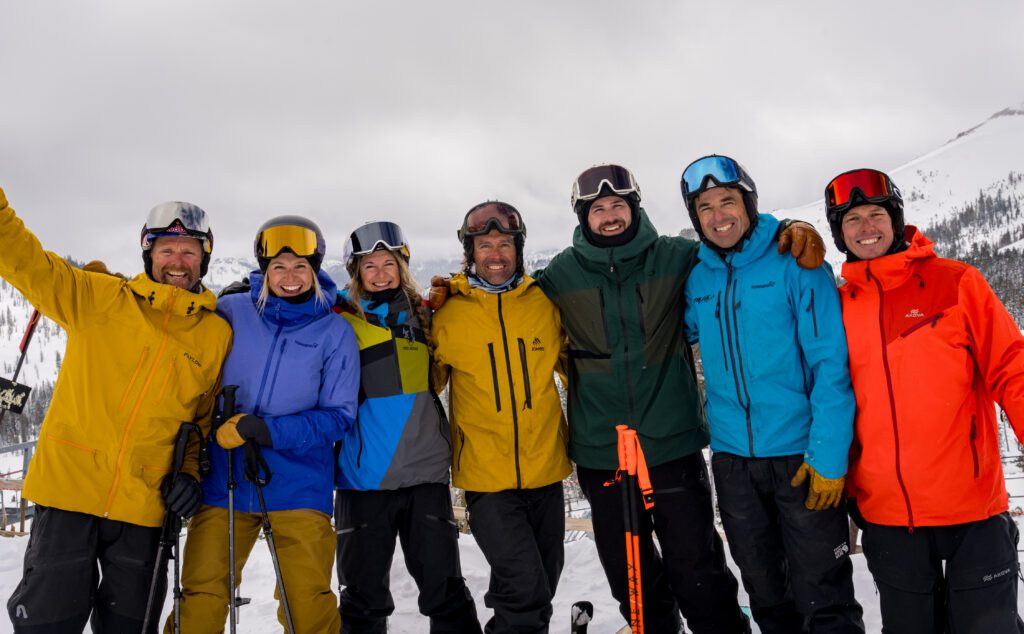
Michelle smiling with fellow Palisades Tahoe pro athletes: Daron Rahlves, Amie Engerbretson, Jeremy Jones, Troy Murphy, JT Holmes, and Connery Lundin.
This interview was conducted in the fall before Greg Parker passed away. In August 2025, Michelle married Aaron Blatt in Lake Tahoe, surrounded by her friends, family, and her father — a moment she had always dreamed of. In January 2026, Michelle and her family honored Greg with a celebration of life at Olympic Valley.
How do you approach resilience in your life?
A lot about my approach to resiliency comes from my dad. He’s been my best friend, biggest supporter, and biggest advocate. I remember having a meltdown after my biggest injury. He set a timer and told me to cry for ten minutes, and after it went off, we would be positive. I cried for my ten allotted minutes, then once it beeped, my mindset shifted. It felt like I was turning a new page. That moment really sticks out as one of my favorite life lessons. My dad has always been extremely positive, even through his diagnosis of Parkinson’s and progression into Lewy Body Dementia.
When I visited South America, I saw homes spanning generations with kids in their mid-20s alongside grandparents and I felt inspired by the closeness. When my dad was diagnosed, I knew I was going to be there for him. The time we spend together includes some of the hardest moments, but also the most wonderful. My dad demonstrated how to move through challenges with grace and do your absolute best. Taking care of him has been the biggest expedition of my life.
What were some of the most memorable moments from your wedding this summer?
Aaron and I have been engaged for a couple of years. As I’ve touched on, my dad’s diagnosis shifted my life and inspired a quickly planned wedding. We planned the wedding in a month, so that he could be there and walk me down the aisle. It was the highlight of my entire life.
It was such a special day with my family and friends. I was so thankful for my brother’s effort that day. It was unbelievable and one of the best wedding speeches I’ve ever witnessed.
My dad had a good day. He met me at the end of a pier and walked me down the aisle. Aaron and I were going through our wedding photos, and he asked, “What were you thinking when you were walking down the aisle?” I said, “I didn’t want my dad to fall in the water, so I was really concentrating on getting there!”
I was recently looking at the photos, and there are so many beautiful captures of him looking like a GQ model with his gray hair and dressed up in a suit. When big life moments happen, he’s been really present — I’m so thankful that he was able to share that day with all of us.
Check out the previous blogs featuring our pro athlete team and stay tuned for the remaining athlete interviews!
| Blog Series |
| • Jonny Moseley |
| • JT Holmes |
| • Amie Engerbretson |
| • Connery Lundin |
| • Bryce Bennett |
| • AJ Hurt |
| • Michelle Parker |